The Ultimate Flatmate Chore Schedule: How to Keep Everyone Happy
Ultimate flatmate chore schedule guide 2026. 4 rotation systems, templates & apps that actually work. Stop arguing about cleaning today ✓
The Ultimate Flatmate Chore Schedule: How to Keep Everyone Happy
Ask anyone who's lived in a shared flat what causes the most arguments, and the answer is almost never rent. It's the dishes in the sink. The hair in the shower drain. The kitchen counter that hasn't been wiped in what feels like geological time.
A 2024 survey by Flatmates.com.au found that 62% of share house disputes are about cleaning. Not money, not noise, not having people over — cleaning. And the reason is simple: unlike rent, which gets agreed on once and stays fixed, chores are a daily, ongoing negotiation that most flats never bother to formalize.
This guide will walk you through creating a chore schedule that actually sticks. Not a utopian fantasy where everyone happily mops floors while singing, but a realistic system that prevents the slow build-up of resentment that kills shared living.
Why a Written Schedule Beats "Common Sense"
Every flat starts the same way. Someone says "We're all adults, we'll just clean up after ourselves." Everyone nods. It sounds reasonable.
Fast forward three weeks. The bin is overflowing because everyone assumes someone else will take it out. There's a mysterious pan "soaking" in the sink that's been there since Tuesday. One roommate has cleaned the bathroom twice; another hasn't touched it once.
The problem isn't that your flatmates are lazy or inconsiderate (most of the time). It's that "clean up after yourself" means radically different things to different people. For some, it means wiping down the kitchen counter every time they cook. For others, it means doing a big clean once a week. Neither is wrong — they're just different.
A written schedule removes ambiguity. When it's your name next to "bathroom — Thursday," there's no question about whose turn it is. It sounds rigid, but it actually creates more freedom because people stop keeping mental tallies and feeling quietly resentful.
Step 1: List Every Shared Chore
Sit down together (not via text — in person, or at least on a video call) and list everything that needs doing. People chronically underestimate how many chores a flat requires because they only notice the ones they personally do.
Daily chores
- Wash your own dishes (or load/unload dishwasher)
- Wipe kitchen counters after cooking
- Take out rubbish when the bin is full
Weekly chores
- Vacuum/mop shared areas (living room, hallways)
- Clean the bathroom(s) — toilet, shower, sink, mirror
- Clean the kitchen properly — oven top, splashback, appliances
- Take out recycling
- Water plants (if any)
Fortnightly or monthly chores
- Clean the fridge (throw out expired food, wipe shelves)
- Clean the oven
- Dust shelves, windowsills, surfaces
- Wash communal items (sofa throws, kitchen towels, bath mats)
- Clean windows
- Mop behind/under furniture
Seasonal or as-needed
- Deep clean before/after someone moves in or out
- Defrost freezer
- Clean extractor fan/filters
- Clear drains
Write them all down. Seriously, all of them. The chores that don't make the list are the ones that cause problems later because someone ends up doing them silently and resentfully.
Step 2: Agree on Frequency and Standards
This is where most schedules fall apart — not because people disagree about whose turn it is, but because they disagree about what "cleaning the bathroom" means.
Define "done"
For each chore, briefly describe what "done" looks like:
- Clean the bathroom: Scrub toilet inside and out, clean shower walls and drain, wipe sink and mirror, sweep/mop floor, replace towel if communal.
- Clean the kitchen: Wipe all surfaces including splashback, clean stovetop, wipe down appliances, sweep floor, empty any food from sink drain.
- Vacuum shared areas: All rooms, under the coffee table, along edges. Move small furniture if needed.
This doesn't have to be a military inspection checklist. Just enough that everyone has the same picture in their head.
Agree on frequency
Some people think the bathroom needs cleaning every three days. Others think once a week is plenty. Find a middle ground that everyone can live with — literally. If you have four roommates and assign bathroom duty weekly on rotation, each person cleans it once a month. That's very manageable.
A reasonable default for most flats:
- Kitchen wipe-down: daily (by whoever cooked)
- Bathroom: weekly
- Vacuum/mop shared spaces: weekly
- Fridge clean-out: every two weeks
- Deep tasks (oven, windows): monthly
Step 3: Choose a Rotation System
Option A: Weekly rotation
The simplest approach. Assign each person a "zone" that rotates weekly.
| Week | Person A | Person B | Person C |
|---|---|---|---|
| 1 | Bathroom | Kitchen | Floors |
| 2 | Floors | Bathroom | Kitchen |
| 3 | Kitchen | Floors | Bathroom |
| 4 | Bathroom | Kitchen | Floors |
Pros: Dead simple, everyone does everything eventually, nobody can claim they always get stuck with the worst job.
Cons: Doesn't account for different workloads (deep-cleaning the kitchen takes longer than vacuuming). Can be annoying if your "bathroom week" always falls when you're busy.
Option B: Preference-based assignment
Let people choose chores they hate least. Surprisingly often, preferences don't overlap much. One person genuinely doesn't mind cleaning the bathroom. Another would rather vacuum than touch the oven. Use that.
Pros: People are more likely to actually do chores they've chosen. Less complaining.
Cons: Some chores are universally disliked (cleaning the oven, taking out bins in the rain). These need to rotate regardless.
Option C: Points-based system
Assign difficulty points to each chore and ensure everyone accumulates roughly equal points each week.
- Clean bathroom: 3 points
- Deep clean kitchen: 3 points
- Vacuum and mop: 2 points
- Take out bins/recycling: 1 point
- Wipe kitchen counters: 1 point
- Water plants: 1 point
Each person aims for ~5 points per week. They can mix and match.
Pros: Accounts for effort differences. Flexible.
Cons: More overhead to track. Someone needs to maintain the system.
Option D: Random assignment
Use an app or a simple random draw each week to assign chores. Eliminates accusations of bias.
Pros: Nobody designed the schedule, so nobody can feel targeted.
Cons: Doesn't account for preferences or availability. Purely random systems can produce annoying streaks (cleaning the bathroom four times in a row).
Step 4: Track Accountability
A schedule that exists only in people's memories isn't a schedule — it's a suggestion. You need it written down somewhere that everyone can see.
The whiteboard approach
A physical board on the fridge or kitchen wall. Classic for a reason. You can see it every day, check things off satisfyingly, and it's impossible to ignore.
Downside: Doesn't send reminders, doesn't work if someone is away, and you have to manually update it.
The shared spreadsheet
Google Sheets with a rotation table and checkboxes. Everyone has access and can see what's been done.
Downside: Out of sight, out of mind. Nobody opens a spreadsheet voluntarily.
The dedicated app
This is where digital tools genuinely shine. Apps built for shared living let you set up recurring tasks with automatic rotation and reminders. HouseKeepr handles this well — you create a task, set it to weekly, assign it to rotate between flatmates, and everyone gets notified when it's their turn. If someone completes a task, the whole flat can see it.
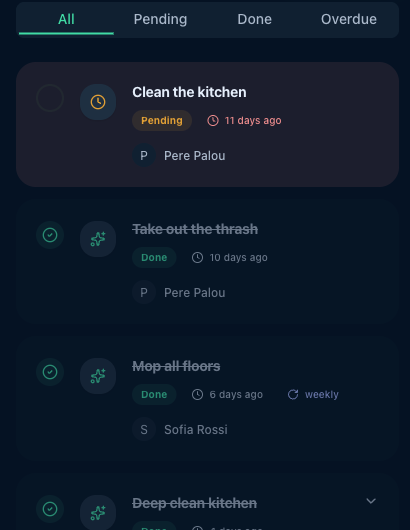
The advantage over a whiteboard is push notifications. The advantage over a spreadsheet is that it's on your phone, not buried in a browser tab.
Whatever method you pick, the key principle is the same: make the system visible and low-effort to maintain.
Common Pitfalls (and How to Avoid Them)
The "different standards" problem
Person A thinks the kitchen is clean when the surfaces are wiped down. Person B thinks it's clean when you could perform surgery on the floor. This is the number one chore conflict, and no schedule will fix it by itself.
Solution: Have the standards conversation explicitly (see Step 2). If you can't agree, default to the higher standard with the understanding that whoever does the chore can do it their way as long as it meets the agreed minimum. If Person B wants the floor surgeon-clean, Person B can do the extra step during their turn.
The "I'm busy this week" spiral
Someone skips their turn because of a work deadline, exam, or trip. Totally reasonable once. But if it keeps happening without a swap, the system collapses.
Solution: Allow swaps, not skips. If you can't do your chore this week, trade with someone. This keeps the workload balanced and creates a favour economy rather than a free-rider problem.
Passive-aggressive notes
The handwritten note on a dirty pan that says "This is NOT a decoration" has started more flatmate cold wars than anything else in human history.
Solution: If someone isn't doing their chores, talk to them directly. One-on-one, calmly, with specifics. "Hey, the bathroom hasn't been cleaned for the last two weeks during your turns — everything okay?" works. A sticky note doesn't.
The "invisible chore" resentment
Someone always replaces the toilet roll, buys the washing-up liquid, or takes in the delivered packages. These tasks aren't on any schedule but they take time and money.
Solution: Add them to the list. Either rotate them formally or acknowledge them as that person's contribution and adjust other chores accordingly.
One person becoming the "chore manager"
Organising the schedule, reminding people, updating the board — this is work too, and it usually falls on one person. Over time, they resent being the flat's unpaid project manager.
Solution: Use a tool that automates the nagging. Rotating reminders from an app are much less annoying than a flatmate saying "have you done the bathroom yet?" for the third time. This alone is a good enough reason to use a digital system.
A Sample Weekly Schedule for a 3-Person Flat
Here's a ready-to-use template:
Daily (everyone, every day):
- Clean up after yourself in the kitchen immediately after cooking
- Put rubbish in the bin, not next to it
Weekly rotation:
| Chore | Week 1 | Week 2 | Week 3 |
|---|---|---|---|
| Bathroom deep clean | Alex | Sam | Jordan |
| Kitchen deep clean | Sam | Jordan | Alex |
| Vacuum & mop all shared areas | Jordan | Alex | Sam |
| Take out rubbish + recycling | Alex | Sam | Jordan |
Fortnightly (rotates):
- Clean fridge (throw out old food, wipe shelves)
- Wash kitchen towels and bath mat
Monthly (rotates):
- Clean oven
- Dust all surfaces
- Clean windows in shared areas
Deadline: All weekly chores done by Sunday evening. If you can't make it, arrange a swap by Friday.
Copy it, adapt it, stick it on the fridge or put it in your flat's app.
What Actually Keeps a Schedule Working
After all the systems and templates, here's what really matters:
Consistency beats perfection. A mediocre schedule that runs every week is infinitely better than a perfect one that gets abandoned after two weeks.
Make it easy to see who did what. Visibility creates gentle accountability without anyone needing to play police.
Celebrate completion, don't just punish failure. A quick "nice one, kitchen looks great" in the flat chat goes further than you'd think.
Review and adjust. If the schedule isn't working after a month, change it. Maybe the kitchen deep clean is too much for one person. Maybe weekly is too frequent for some tasks. Treat it as a living document.
Don't use chores as a power dynamic. The person who set up the schedule doesn't get to exempt themselves from the worst tasks. The person who earns the most doesn't get a free pass. Shared space means shared responsibility.
If you're looking for a tool that handles chore rotation, reminders, and everything else that comes with shared living, HouseKeepr is built exactly for this. Free to start, and it takes the "chore manager" burden off any single person. But even if you go old-school with a whiteboard and a marker, what matters most is having any system at all — because the alternative is always worse.
You Might Also Like
Ready to manage your shared home?
Start using HouseKeepr for free — split expenses, assign tasks, and keep your flat running smoothly.
Get Started Free →