Shared Flat Rules Template: The Complete Guide to House Rules That Work
Ready-to-use shared flat rules template covering cleaning, noise, guests, bills and more. Prevent 90% of flatmate conflicts before they start.
Shared Flat Rules Template: The Complete Guide to House Rules That Work
Most flatmate conflicts are not really about the thing they appear to be about. The argument about the dishes isn't about the dishes. It's about the fact that one person's informal understanding of "clean up after yourself" means immediately, and another person's means eventually. Nobody agreed on which, so both people feel reasonable while also feeling wronged.
Written house rules fix this. Not because they make everyone perfect, but because they replace interpretations with agreements. This guide gives you a complete shared flat rules template covering every major category, a process for getting flatmates to actually commit to the rules, and advice on when written rules need to become a direct conversation.
Why Written House Rules Prevent 90% of Flatmate Conflicts
The vast majority of flatmate disputes fall into a small set of categories: cleaning expectations, noise, guests, shared food, and bills. What makes them disputes rather than simple problems is that each person has a default assumption about how these things work — and those assumptions were never made explicit.
Unwritten rules create three predictable problems:
The assumption gap. You assume a quiet weeknight means no guests after 10pm. Your flatmate assumes it means noise levels stay reasonable whenever. Nobody lied. Nobody was unreasonable. But you're going to have a problem at 11:30 on a Wednesday.
The interpretation gap. "Take turns cleaning the kitchen" means weekly to you and when it gets bad to your flatmate. This is not a character flaw — it's a calibration mismatch that written rules resolve immediately.
The memory gap. "We agreed you'd handle the internet bill" is a lot harder to dispute when it's in a signed flat agreement rather than a conversation three months ago that both people remember differently.
A survey by SpareRoom found that 78% of flatmates who experienced serious conflicts wished they had set clear expectations in writing from the start. The ones who did have written agreements reported significantly fewer ongoing disputes.
The goal is not to legalize your shared living or create a contract you'll wave at each other. It's to surface everyone's default assumptions before they collide, then agree on a shared set of defaults. That conversation, not the document, is what prevents most conflicts.
The 8 Essential Categories for Shared Flat Rules
Every shared flat needs rules across these eight areas. Some will be short. Some will need detail. All of them need to be explicit.
1. Cleaning and Chores
This is the single largest source of flatmate conflict, and it is almost always a standards mismatch rather than a laziness problem. Your rules need to cover:
- Which shared spaces are everyone's responsibility (kitchen, bathrooms, living room, hallway, shared outdoor space)
- How often each area gets cleaned (weekly, fortnightly, monthly)
- What "clean" means for each area — enough detail that two people doing it would produce the same result
- How the chore rota works: weekly rotation, fixed assignments, or preference-based
- What happens when someone misses their turn (arrange a swap, not just skip)
- Who buys communal cleaning supplies and how the cost is shared
Cleaning is the one area where vagueness causes the most damage. Invest time here.
2. Noise and Quiet Hours
The most common noise conflicts are not parties — they're the chronic low-level stuff: music at 7am, calls on speaker phone in shared spaces, someone pacing while on a work call. Agree on:
- Quiet hours on weeknights (a common default: 11pm to 8am)
- Quiet hours on weekends (often slightly later: midnight to 9am)
- Where loud calls, video meetings, and media consumption are acceptable during quiet hours
- How much notice is needed before a party or event with external guests
- Acceptable noise from instruments, gaming, or exercise equipment
3. Guests
Guest rules cover everything from an overnight visitor to someone who's been sleeping on your flatmate's sofa for the past three weeks. Be specific:
- Advance notice required for overnight guests (same day, 24 hours, 48 hours)
- Maximum consecutive nights for one guest before it becomes a problem
- Rules about using shared facilities (bathroom, kitchen) when guests are present
- What to do if the guest situation feels like a de facto new flatmate
- Whether partners staying frequently contribute to shared costs
4. Shared Spaces and Personal Belongings
Clear territory rules prevent passive-aggressive fridge labelling and counter wars:
- Which fridge shelves belong to whom (or is it communal?)
- Rules about borrowing each other's food without asking
- Personal items left in shared spaces — bathroom products, sports equipment, bags
- Whether communal items (oils, condiments, cleaning products) are shared costs
- Expectations about living room use when others want to use it
- Any claimed personal spaces (a desk in the living room, a specific kitchen cupboard)
5. Bills and Shared Expenses
Financial rules should be written even if the amounts seem too small to matter:
- Which bills are everyone's responsibility and which are personal
- When monthly contributions are due (by the 1st? by the 3rd?)
- What happens when someone is late (reminder period before it becomes a formal issue)
- How shared grocery and supply costs are tracked and settled
- Which app you're all using for expense tracking
- Process for large unexpected shared expenses (appliance breakdown, plumber)
6. Food and the Kitchen
Shared kitchens are ground zero for the most petty and persistent conflicts. Cover:
- Shared vs. personal food — what can anyone use vs. what is off-limits
- How to handle communal staples (cooking oil, herbs, condiments)
- The expectation for cleaning up after cooking (immediately vs. by end of day)
- Rules about leaving dishes to "soak" and for how long
- Smelly cooking — is there an expectation to ventilate, or a soft curfew on strong smells?
- Fridge organisation and how expired food gets cleared out
7. Maintenance and Flat Upkeep
Day-to-day maintenance is the invisible work that always falls to whoever cares most unless it's been agreed:
- Who contacts the landlord about maintenance issues
- Expected response time from flatmates when a landlord message needs reply
- Who handles things that need coordination but no professional (changing lightbulbs, testing smoke alarms, clearing the drain)
- How to handle a maintenance dispute with the landlord as a group
- Expectations around moving furniture or making minor modifications to shared spaces
8. Move-Out and End of Tenancy
These rules rarely get discussed until someone announces they're leaving:
- Notice period for leaving the flat (beyond legal requirements — how much warning is respectful?)
- Who is responsible for finding a replacement flatmate
- How to handle a deposit or room contribution paid to other flatmates
- Deep cleaning responsibilities before someone leaves
- Return of any shared items purchased together
Ready-to-Use House Rules Template
Copy this, adapt the specifics to your flat, and use it as a starting point for your house meeting. Delete sections that don't apply.
[FLAT NAME / ADDRESS] — House Rules and Flatmate Agreement
Agreed on: [DATE]
Flatmates: [NAMES]
Cleaning and Chores
- [ ] Shared spaces cleaned on the following schedule: kitchen (weekly), bathrooms (weekly), floors/vacuuming (weekly), fridge clear-out (fortnightly)
- [ ] Chore rotation: [weekly rotation / fixed assignments / preference-based — specify names and assignments]
- [ ] "Clean kitchen" means: surfaces wiped, stovetop cleaned, sink empty, appliances wiped, floor swept
- [ ] "Clean bathroom" means: toilet scrubbed, shower/bath cleaned, sink and mirror wiped, floor mopped
- [ ] If you can't do your chore this week, arrange a swap with a flatmate before the deadline
- [ ] Deadline for weekly chores: Sunday evening
- [ ] Communal cleaning supplies bought by [rotation / designated person] and costs shared equally
Noise and Quiet Hours
- [ ] Weeknight quiet hours: 11pm to 8am
- [ ] Weekend quiet hours: midnight to 9am
- [ ] Phone calls and video calls taken in bedrooms or with headphones during quiet hours
- [ ] Guests at flat events: minimum [48 hours / 1 week] notice to other flatmates
- [ ] Music/media: use headphones or keep to bedroom after quiet hours begin
Guests
- [ ] Overnight guests: give [same-day / 24-hour / 48-hour] notice via flat group chat
- [ ] Maximum consecutive nights for one guest without discussion: [3 / 5 / 7] nights
- [ ] Long-term stays (more than [2 weeks] in a month): discuss with all flatmates
- [ ] Guests use shared spaces considerately; host is responsible for their behaviour
Shared Spaces
- [ ] Fridge shelves assigned to: [Name - shelf, Name - shelf]
- [ ] Communal fridge items: [cooking oil, condiments, butter — yes/no]
- [ ] Personal food labelled if you want it kept separate
- [ ] Expired food cleared every [fortnight] — anyone can do it
- [ ] Personal items in shared spaces: return to your room within [24 hours / end of day]
- [ ] Living room: shared space, no one person has priority; check the group chat if you want to use it for a long period
Bills and Expenses
- [ ] Monthly bill contributions due by the [3rd] of each month
- [ ] Expense tracking: we use [HouseKeepr / Splitwise / other] for shared costs
- [ ] Shared grocery/supply costs: log in the app; settle monthly
- [ ] If someone is late on their share: one reminder, then discuss; don't let it build up
- [ ] Unexpected shared costs over [€50]: discuss as a group before committing
Food and Kitchen
- [ ] Clean up immediately after cooking (or within [1 hour max])
- [ ] "Soaking" dishes maximum: [overnight — then they must be washed]
- [ ] Shared condiments and cooking oils: [list what is communal]
- [ ] Strong-smelling cooking: open windows, run extractor fan
- [ ] Do not use labelled personal food without asking
Maintenance
- [ ] Maintenance issues: inform all flatmates before contacting the landlord (unless urgent)
- [ ] Response to group messages about maintenance: within [24 hours]
- [ ] Minor tasks (lightbulbs, drain clearing): whoever notices it either does it or flags it in the group chat within [24 hours]
Move-Out
- [ ] Notice to flatmates of intention to leave: [1 month] before legal notice to landlord
- [ ] Person leaving is responsible for: finding a replacement candidate (final decision by existing flatmates), thorough bedroom clean, removing all personal items
- [ ] Deep clean of shared spaces before leaving: [yes, shared responsibility / yes, leaving person's responsibility]
All flatmates have read and agreed to these rules. Any updates require group discussion and unanimous consent.
Signed: [signatures or typed names]
How to Hold a House Meeting to Agree on Rules
Writing good house rules is one step. Getting everyone to actually commit to them is another. A structured house meeting makes the difference between rules that feel imposed and rules that feel genuinely agreed on.
Before the meeting
Send the draft template to all flatmates 48 hours before so nobody is reading it cold. Ask each person to mark anything they want to change or discuss. This turns the meeting from a negotiation from scratch into a review of one proposal.
During the meeting
Keep it short. Most flatmates' eyes glaze over after 30 minutes of house admin. A well-prepared meeting should take 20-30 minutes.
Go section by section. For each one, ask if anyone wants to change anything. Most sections will need no discussion at all. Spend time on the contentious ones.
Avoid positions, focus on reasons. If someone wants stricter quiet hours, ask why — they might have a work pattern others hadn't considered. If someone wants more flexibility on guests, ask what they're anticipating. Solutions tend to emerge when people explain their reasoning rather than just stating preferences.
Write down every change agreed in real time. Someone should be designated to update the document live.
End with everyone explicitly saying they're happy with the outcome — not just nodding. The explicit confirmation matters for buy-in.
After the meeting
Share the finalised rules with all flatmates in writing within 24 hours, while the meeting is still fresh. This is your shared reference document.
Store it somewhere everyone can access — a shared note, a flat group, or HouseKeepr's House Rules feature, which lets you store rules with read receipts so there's no later dispute about whether someone saw them.
Digital Tools for Managing House Rules
Physical copies of rules get lost. Shared Google Docs get forgotten. What actually works is a system that sits alongside the apps your flat uses day to day.
HouseKeepr House Rules lets any flatmate add and update house rules, tracks when each flatmate has read them, and timestamps each addition. This solves the "I never saw that rule" problem that arises when rules are updated by one person and not communicated to the rest. Rules sit alongside expenses, tasks, and the shopping list, so the whole flat is in one place.
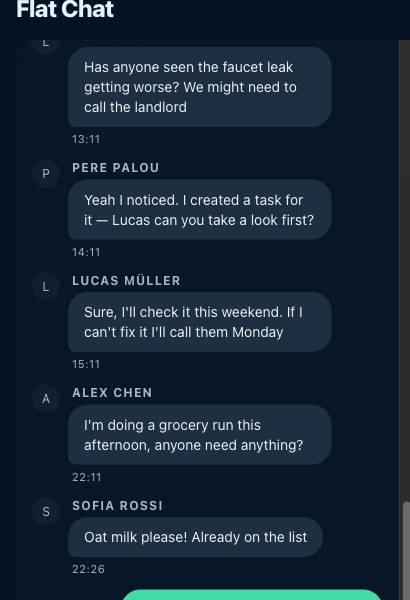
For chore-related rules, pairing your written agreement with a task management system means rules don't rely on memory. When "bathroom cleaned by Sunday" is a rule and a recurring task with rotation and reminders, it runs automatically. See our full guide on setting up a flatmate chore schedule for the mechanics of making this work.
FAQ: Shared Flat Rules and House Rules Templates
Do flatmate house rules have any legal standing?
A signed flatmate agreement has moral and social weight, but it is not typically a legally enforceable contract in the way a tenancy agreement is. Its value is relational, not legal — it aligns expectations, creates shared accountability, and gives you a reference point for difficult conversations. If financial arrangements between flatmates need legal backing, consult a tenancy agreement template for your jurisdiction.
What should you do when a flatmate breaks the house rules?
Address it directly and promptly, before it becomes a pattern or a loaded grievance. The goal is a conversation, not an accusation. "The bathroom wasn't cleaned during your turn last week — is everything okay, or do we need to adjust the schedule?" works much better than passive-aggressive notes or a confrontational meeting. The written rules give you a neutral reference point rather than a personal complaint.
How often should house rules be updated?
Review them when someone new moves in (they should have full input), when someone moves out, and at the start of each academic or calendar year for longer tenancies. A rule that worked for a four-person flat with matching work schedules might not work after someone starts a job with night shifts. Treat the rules as a living document, not a one-time setup.
What if a flatmate won't agree to any rules?
Some resistance is normal — people dislike the implication that they need rules. The framing matters enormously. "Let's get clear on our shared expectations so nobody's guessing" works much better than "we need rules because of what happened last month." If someone genuinely refuses to engage with any form of shared agreement, that is useful information about how the living arrangement is likely to go. It is better to surface that before you sign a lease together than after.
The Bottom Line
House rules do not create perfect flatmates. They create a shared frame of reference that prevents the majority of conflicts from arising in the first place — and gives everyone a constructive way to address the ones that do.
Use the template above as your starting point, adapt it to your flat's specifics, and hold a short meeting to get genuine buy-in from everyone. Then store it somewhere all flatmates can access and revisit it when someone new joins.
The 30 minutes you spend on this conversation is likely to save hours of awkward silences, passive-aggressive notes, and full-scale arguments over the coming months.
Start your flat on HouseKeepr to manage house rules, expenses, chores, and everything else that comes with shared living.
You Might Also Like
Ready to manage your shared home?
Start using HouseKeepr for free — split expenses, assign tasks, and keep your flat running smoothly.
Get Started Free →