How to Manage Flatmates: A Stress-Free Guide for 2026
Learn how to manage flatmates without the stress. 5 proven pillars covering communication, finances, chores, boundaries and conflict resolution.
How to Manage Flatmates: A Stress-Free Guide for 2026
Living with flatmates is one of the more demanding social arrangements most people encounter — more intimate than colleagues, less formal than family, and with the added complexity of shared finances, shared chores, and shared space. When it works, it's one of the most enjoyable living situations there is. When it doesn't, it makes home feel like something to escape rather than return to.
The difference between flats that work and flats that don't usually has nothing to do with how compatible the personalities are. It comes down to whether the flat has functioning systems for the five things that define shared living: communication, finances, chores, boundaries, and conflict resolution. This guide covers all five in practical detail.
Why Flatmate Management Is a Real Skill
Nobody teaches you how to live with people. You absorb it through trial and error, mostly in your 20s, largely at the expense of flatmates who deserved better and your own peace of mind.
The word "management" sounds corporate, but it's accurate. You are coordinating multiple people with different habits, schedules, expectations, and financial situations in a shared space. That requires structure, communication, and occasional difficult conversations — exactly the same skills as any other coordination challenge.
The good news is these skills are learnable and they compound. A flat that builds good systems in the first month of a tenancy runs smoothly for years. A flat that defers every uncomfortable conversation runs into increasingly entrenched problems that become harder to address the longer they're left.
The 5 Pillars of Effective Flatmate Management
Pillar 1: Communication
Everything else depends on this. The most well-designed chore rota and the most careful expense tracking system will fall apart if flatmates can't actually talk to each other about problems when they arise.
Set up a communication channel immediately
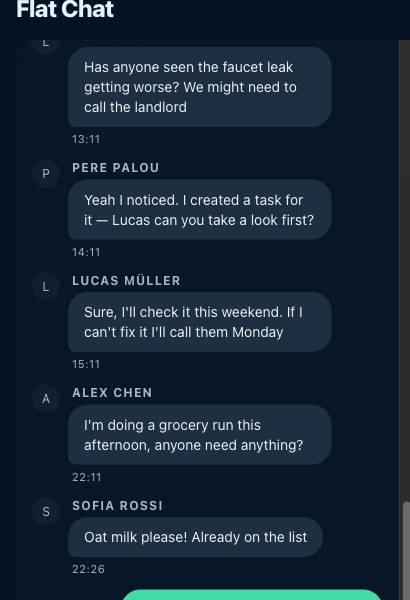
Before move-in, create a group chat that all flatmates are in and that is specifically for flat business. Separate from social chat if possible — when flat admin is buried in memes and holiday photos, important messages get missed.
Use the group chat for:
- Maintenance issues that affect everyone
- Schedule information (extended absences, guests coming)
- Shared purchases that need discussion
- Reminders about shared tasks
Use direct messages for:
- Issues with one specific flatmate (never call someone out in the group)
- Positive feedback ("thanks for sorting the internet bill")
- Sensitive topics that deserve a private conversation first
Default to direct communication
The most common mistake in shared flats is the indirect communication pattern: someone is frustrated, they mention it to another flatmate rather than the person involved, that flatmate mentions it back, and now there are hurt feelings and nobody has actually addressed the problem.
If something is bothering you, address it with the relevant person within 48 hours. The longer you wait, the more charged the conversation becomes and the more likely it is to come out wrong.
Keep the focus on behaviour, not character. "The kitchen was left with dishes in the sink for three days this week — can we figure out a solution?" works. "You're so messy" creates a defensive reaction and no outcome.
Hold occasional flat meetings
A 20-minute check-in once a month or once a quarter prevents small issues from becoming big ones. Use it to review how the chore rota is working, discuss any upcoming changes (someone working from home more, expecting a relationship partner to visit more), and surface anything that needs group input before it becomes a problem.
Keep it practical, not therapeutic. The goal is to adjust systems and flag logistics, not to process feelings in a group setting.
Pillar 2: Finances
Money is the second-largest source of flatmate conflict after cleaning, and it's the one most people avoid discussing because it feels rude or awkward. The avoidance makes it worse. The flats that handle finances best treat shared expenses like a functional admin task rather than a sensitive personal topic.
Choose one system and make everyone use it
A shared expense tracker only works when everyone is on it consistently. Choose your app before move-in, all install it, and agree to log shared expenses as they happen rather than trying to reconstruct them at the end of the month.
The options range from simple to comprehensive. Splitwise is the most widely used pure expense tracker. HouseKeepr combines expense tracking with chore management and flat communication, which reduces the number of separate tools the flat needs. The most important thing is consistency — the best expense app is the one your whole flat actually uses.
Handle recurring bills explicitly
Rent, internet, electricity, and water happen every month. Decide upfront who pays what and how it gets reimbursed. Options:
- One person handles all bills, others transfer their share — simple but puts one person in a financially vulnerable position
- Bills split between flatmates (person A pays rent and electricity, person B pays internet and water) — distributes responsibility but requires tracking to stay balanced
- All bills go through a shared tracker — most transparent, easiest to audit
Whatever you choose, write it down and put deadlines on it. "Transfer your share by the 5th of each month" prevents the common pattern where one person floats costs for weeks while waiting for reimbursement.
Have the money conversation before problems start
The most common financial conflict pattern: one flatmate is chronically late on their share. Another flatmate covers it quietly for months. The resentment builds. Eventually it explodes in a way that's disproportionate to the actual amount of money involved.
Address payment delays the first time they happen, not the fifth. A simple "Hey, the electricity split is still outstanding — can you send it this week?" sent on the 7th is not rude. Waiting until the 4th month and then losing your temper is.
For a detailed guide on splitting the largest shared cost, read our article on how to split rent fairly with roommates.
Pillar 3: Chores
Chore management is where the most flatmate relationships quietly deteriorate — not in dramatic arguments, but in the slow accumulation of unspoken resentment. The person who always cleans the bathroom. The person who never replaces the bin bag. The invisible labour that one flatmate provides and another doesn't notice.
Build a system, not a vibe
"We'll just keep things tidy" is not a system. It's an invitation for the tidiest person to either do everything or go quietly mad. A functioning chore system has three components:
- A list of all shared tasks — not just the obvious ones, but the ones people fight about later because they weren't on anyone's radar (cleaning the oven, buying cleaning supplies, clearing the drain)
- A rotation or assignment — who does what and when, with enough specificity that there's no ambiguity
- Visibility — the rota should be somewhere everyone can see it, not just in someone's memory
Match the system to your flat
Different flats need different approaches:
- 4+ people, similar schedules: Weekly rotation works well. Everyone does the same set of tasks, moving through each area in turn.
- Mixed schedules: Fixed assignments (the person who's home most handles daily kitchen tidying; the late-working flatmate takes monthly deep cleans) often work better than strict rotation.
- Flats with widely different standards: Preference-based assignment (let people choose what they hate least) reduces conflict. Someone genuinely doesn't mind cleaning the bathroom. Another person would rather vacuum every day than touch the oven.
Use reminders, not nagging
The single biggest source of chore-related resentment is one flatmate becoming the default chore manager — the person who notices when tasks need doing and has to remind everyone else. This feels like parenting, and it breeds contempt in both directions.
Apps with automated reminders remove this burden. When the task management system sends the notification, nobody has to be the one who said it. Tools like HouseKeepr handle this automatically — tasks rotate, reminders go to the right person at the right time, and completion is visible to the whole flat without anyone tracking it manually.
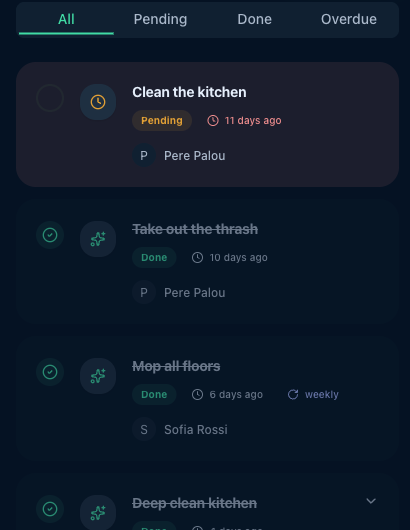
For the full deep-dive on chore systems, templates, and accountability approaches, see our guide on creating a flatmate chore schedule that actually works.
Pillar 4: Boundaries
Shared living requires constant renegotiation of personal space, private time, and individual autonomy. The flats that handle this best are the ones where boundaries are stated rather than assumed.
Articulate your own needs before they become grievances
It is far easier to say "I have video calls until 6pm most weekdays, so I need the living room quiet until then" on move-in day than to wait until your flatmate has been watching TV at 2pm for three weeks before bringing it up.
The rule of thumb: if something will definitely matter to you, say so early. It's not demanding to share information about how you work and live. It prevents problems that would otherwise be inevitable.
Respect varying social needs
Some flatmates want the flat to be a social hub. Others see it as a private retreat. Neither is wrong, but the combination is combustible without explicit conversation.
Talk about it early: How often is it okay to have friends over? What's the expectation around being sociable when flatmates are in shared spaces — is everyone expected to chat, or is it okay to just be in the same room doing separate things? What's the expectation around knock-before-entering for bedrooms?
These conversations feel forced but take about five minutes and prevent months of weirdness.
Guest policies need to be explicit
The guest question is where "boundaries" gets most concrete. A partner who stays three nights a week is effectively a partial resident and adds a meaningful load to shared spaces, utilities, and the social atmosphere of the flat. Most flats avoid discussing this until it's already a problem.
State a policy early: reasonable notice for overnight guests, an upper limit on consecutive nights before a conversation is warranted, and a general understanding that the flat's character (quiet study household vs. social hub) doesn't change based on whoever is visiting.
Pillar 5: Conflict Resolution
Even well-managed flats have conflicts. The goal isn't to eliminate conflict — it's to resolve it quickly, proportionally, and without residual resentment.
Address issues early and specifically
The most damaging pattern in flatmate conflict is the slow build. Small irritation is ignored. It happens again. Ignored again. Months pass. Then one day something minor happens and the response is wildly disproportionate — because the actual frustration is the accumulated weight of six months of smaller issues.
Address things the first or second time they happen, with a light touch. "Hey, just wanted to mention that the kitchen has been left with stuff in the sink a few times — can we figure out a better system?" at week three is a 30-second conversation. The same conversation at month seven is a serious incident.
Separate the problem from the person
Most flatmate issues are system problems, not character problems. The bin bag doesn't get replaced not because your flatmate is inconsiderate, but because nobody agreed on who replaces it when it gets full. The dishes pile up not because your flatmate is messy, but because their standard for "deal with it immediately" is different from yours.
Framing conflicts as system failures keeps them solvable. Framing them as character failures makes them intractable.
Use a neutral reference point
Written house rules and agreed chore schedules give you something neutral to refer to in a conflict, rather than requiring two people to argue about what they individually believe was agreed.
"According to our cleaning schedule, bathroom was your turn last week" is a factual statement. "You never clean the bathroom" is an accusation. Both might describe the same situation, but only one leads to a productive conversation.
When to involve everyone vs. handle directly
Most flatmate conflicts should be handled one-on-one first. Loop in the whole flat only if the issue affects everyone or if a direct conversation hasn't resolved it after one or two attempts.
If a situation is serious — one flatmate is genuinely unable or unwilling to meet basic shared living commitments — then a flat meeting with all parties present, focused on solutions rather than blame, is the right approach. The framing matters: "How do we fix this?" rather than "What's wrong with you?"
When to escalate
Some situations require external help: a flatmate who genuinely can't pay rent, a situation that has become hostile enough to feel unsafe, or a conflict that stems from a lease-level issue requiring landlord involvement.
Document significant issues in writing (a message thread, an email) before escalating to a landlord or mediator. Written records of specific incidents and attempted resolutions are more useful than a verbal account of ongoing tension.
Common Flatmate Management Mistakes
Passive aggression instead of direct communication
The note on the dirty pan. The loaded passive remark in the group chat. The conspicuous cleaning of a mess that isn't yours while your flatmate can see you.
These approaches feel satisfying for about 30 seconds and create lasting damage. Passive aggression communicates frustration without addressing the actual issue, which means the issue continues while resentment grows on both sides.
Say the thing directly. It's almost always less uncomfortable than the alternatives.
Avoiding money conversations
Money feels rude to bring up. So the person who covered last month's electricity bill doesn't mention it. The person who bought three weeks of communal cleaning supplies doesn't log it. The person who's been late on their share for two months doesn't get a reminder.
Six months later, the financial resentment is real and the amounts are large enough to cause a genuine dispute. The same situations addressed individually, the week they happened, would have been minor admin.
Unwritten, unspoken rules
Every person who has lived in a shared flat has at some point been surprised that something they took as obvious — of course you clean up immediately after cooking, of course you don't use someone else's labelled food — turned out to be a personal assumption rather than a universal truth.
Written house rules are not bureaucratic overkill. They are the fastest way to surface conflicting assumptions before they become conflicts. See our full guide with a ready-to-use shared flat rules template.
Letting small issues accumulate
This is probably the single most common flatmate management failure. The issue is small, the conversation feels disproportionate, so it goes unsaid. Then it's larger but feels late to bring up. Then it's even larger and has become a defining grievance rather than a solvable problem.
The earlier you raise an issue, the easier it is to resolve and the less awkward the conversation. "Early and light" is always better than "late and loaded."
Treating shared living as temporary
Some flatmates invest nothing in the shared arrangements because they view the living situation as purely temporary. This attitude tends to be self-fulfilling — the living situation becomes bad, confirming that it wasn't worth investing in.
Even a six-month tenancy benefits from the first-month investment in systems and agreements. The tools you build in month one run for the rest of the tenancy. The conversations you avoid in month one usually happen anyway — just with more accumulated weight.
Tools and Systems for Flatmate Management
The right tools reduce the management overhead for everyone and remove the need for any single person to carry the coordination burden.
Expense tracking app
Every flat needs one. The choice matters less than everyone using the same one consistently. The options range from pure expense trackers (Splitwise, Tricount) to all-in-one flat management apps that add tasks, shopping, and communication (HouseKeepr).
Chore management
A whiteboard works. A shared spreadsheet works. An app with automated rotation and reminders works better, because it removes the need for any flatmate to manually track and prompt. The key requirement: visibility. The rota needs to be somewhere everyone sees it regularly.
Shared shopping list
A synchronized list means whoever goes to the shop has current information without needing to send messages asking what's needed. This sounds minor until you've made three separate supermarket trips because the shopping list was a chat thread and half the items were already bought.

House rules document
Store this somewhere accessible and permanent. A shared note works. HouseKeepr's House Rules feature stores rules with timestamps and read receipts, which solves the "I never saw that rule" problem that comes up when rules are added by one person and not properly communicated to the rest.
Flat group chat
For logistics, maintenance, and general coordination. Keep it active but not exhausting — the goal is low-friction information sharing, not an obligation to be always-on.
When Things Go Wrong: Conflict Resolution Steps
When a conflict has moved past early-stage to become a real issue, here is a practical process:
Step 1: Name the issue specifically. Not "the flat is a mess" but "the kitchen hasn't been properly cleaned in three weeks and the scheduled person hasn't done their turn." Specific, factual, no character judgements.
Step 2: Have a direct one-on-one conversation. Not a note. Not a group message. A face-to-face or video conversation with the relevant flatmate. Choose a moment when neither of you is rushed or already in a bad mood.
Step 3: Focus on the outcome you want, not the problem. "I'd like the kitchen cleaning schedule to actually run as agreed — can we figure out what's making that hard?" is a productive opening. "You never clean anything" is not.
Step 4: Listen to their perspective. There's usually a reason. Work schedule changes, personal stress, misunderstanding of expectations, or a problem with the system itself. Understanding the reason makes it much easier to find a solution that actually sticks.
Step 5: Agree on a specific change. Not "try harder" but "we'll adjust the schedule so your kitchen turn falls on a different day" or "we'll add the task to the app so reminders are automatic rather than relying on memory."
Step 6: If the one-on-one doesn't work, involve the flat. Sometimes issues affect the whole household dynamic and need a group conversation. Keep the framing solution-focused.
Step 7: If serious issues persist, consider mediation or landlord involvement. Some situations — financial non-compliance, hostile behaviour, significant lease-level problems — need external support. Document specific incidents in writing before escalating.
FAQ: Managing Flatmates
How do you deal with a flatmate who doesn't pull their weight on chores?
Start with a direct, specific conversation — frame it as a system problem rather than a character failing. "I've noticed the bathroom hasn't been cleaned during your scheduled turns for the past few weeks — is there something about the schedule that isn't working?" This opens a dialogue rather than triggering defensiveness. If the issue continues after a direct conversation, a flat meeting to restructure the chore system may be needed. Having a written schedule stored somewhere visible (rather than just agreed verbally) makes these conversations much easier to have.
How should shared expenses be managed fairly?
Choose one expense tracking app and get all flatmates on it before costs start accumulating. Log shared purchases as they happen rather than trying to reconstruct them later. Set a monthly deadline for reviewing and settling balances — monthly is usually frequent enough to avoid large accumulated amounts and infrequent enough to not feel like constant admin. For the biggest shared cost, read our guide on how to split rent with roommates.
What's the best way to find a new flatmate when someone moves out?
Start the process the moment someone announces they're leaving — don't wait for the official move-out date. Existing flatmates should have meaningful input on any replacement. Run a simple vetting process: a video call before any in-person visit, basic lifestyle questions (work hours, social habits, cleanliness expectations), and a gut-check meeting at the flat. The existing flatmates are choosing a new housemate, not just filling a room. A mismatched fit costs months of everyone's wellbeing.
How do you set boundaries with a flatmate without making things awkward?
Frame boundaries as information rather than demands. "I work from home and need quiet until 6pm most days" is sharing a fact about your life. "I need you to be quiet during the day" sounds like a restriction. The more you can present your needs as practical constraints rather than personal preferences, the easier they are for others to respect without feeling judged. Set them early, before a pattern of conflict exists, and the conversation is almost always straightforward.
The Bottom Line
Managing a shared flat well requires the same ingredients as any other successful coordination: clear systems, direct communication, and a willingness to address problems before they become entrenched.
The practical toolkit is simple. Written house rules that surface assumptions before they become conflicts. A shared expense tracker so everyone knows where the money stands. A chore system with visibility and accountability. A group chat for flat logistics. And the habit of raising small issues early rather than letting them compound.
None of this requires flatmates to become close friends or to share the same standards and preferences for everything. It requires enough structure that the shared parts of your lives run smoothly, and enough communication that problems get solved rather than accumulate.
Start your flat on HouseKeepr to manage expenses, chores, shopping lists, and house rules in one place — built for exactly this kind of shared living.
You Might Also Like
Ready to manage your shared home?
Start using HouseKeepr for free — split expenses, assign tasks, and keep your flat running smoothly.
Get Started Free →