How to Split Rent Fairly with Roommates: 5 Methods That Actually Work
How to split rent fairly with roommates: 5 proven methods with real calculations. Equal split, room size, income-based and more. Step-by-step guide for 2026.
How to Split Rent Fairly with Roommates: 5 Methods That Actually Work
You found the perfect flat. The location is great, the price is right, and you have got roommates lined up. Then someone asks the question nobody wants to deal with: "So... how are we splitting rent?"
This single conversation has torpedoed more living arrangements than noisy neighbours and dirty dishes combined. The person in the big room with the balcony thinks equal split is perfectly fair. The person in the windowless box next to the kitchen disagrees — strongly.
Here is the thing: there is no universally correct way to divide rent. But there are methods that feel fair to everyone involved, and that is what actually matters when you are sharing a home. This guide walks through five proven approaches with real calculations, a side-by-side comparison of every method, a section on the best tools for tracking rent, and a comprehensive FAQ — everything you need to have the conversation without it turning into a negotiation.
Why Rent Splitting Causes So Much Conflict
Before getting into methods, it helps to understand why this topic gets heated. Rent is usually the biggest monthly expense for everyone involved. A difference of just 50 euros a month adds up to 600 euros a year — real money for most people, and enough to breed genuine resentment if it feels unfair.
The deeper problem is that "fair" means different things to different people. For some, fair means everyone pays the same because they all share the flat equally. For others, fair means paying proportionally for what you actually get — square metres, amenities, light, quiet.
Neither perspective is wrong. That is exactly why you need to choose a method together rather than assume everyone thinks about it the same way.
The worst outcome is avoiding the conversation entirely and defaulting to an equal split because nobody wanted to bring it up. That breeds resentment over months, and by the time someone finally says something, it is an argument rather than a discussion.
Research from housing advocacy organisations across Europe consistently shows that financial disagreements are the leading cause of flatshare breakdowns — ahead of cleanliness, noise, and guests. Getting rent right from day one is not just about money; it is about whether the flat survives its first year.
Step-by-Step: How to Calculate a Fair Rent Split
Before diving into specific methods, here is the eight-step process that works regardless of which formula you use:
Step 1: Measure every bedroom
Grab a tape measure and get the actual square metres of each room. Include any private storage space like built-in wardrobes or alcoves that belong exclusively to one room. Do not estimate — walk in and measure wall to wall. The difference between "about 10 square metres" and "actually 12.4 square metres" changes the calculation meaningfully.
Step 2: List all room features
Note en-suite bathrooms, balconies, natural light quality, street-facing noise, closet space, proximity to the kitchen or bathroom, and anything else that affects livability. Write these down so they are visible to everyone during the discussion.
Step 3: Agree on a method together
Share this guide and discuss which approach fits your situation before running any numbers. The method should be chosen collectively — if one person designs the system and presents the results, it will always feel biased toward their interest, even if the maths is perfectly fair.
Step 4: Run the numbers
Calculate each person's share using the agreed method. Show the workings to everyone so the process is transparent.
Step 5: Do a gut check
Does each number feel roughly right? Can the person in the cheapest room actually afford even that amount? Does the person in the most expensive room feel like they are being overcharged relative to what they are getting? If something feels off, talk about why before moving on.
Step 6: Round to sensible figures
Nobody wants to pay 487.63 euros. Round to the nearest 5 or 10 euros. Decide collectively where the rounding adjustment lands — usually the person in the largest room absorbs an extra euro or two.
Step 7: Write it down
Add the agreed amounts to a shared note, app, or message thread. If you are using a flat management tool like HouseKeepr, set up rent as a recurring expense so it appears in everyone's balance automatically each month. This eliminates the "I thought we agreed on 420" situation six months later.
Step 8: Set a review date
Agree to revisit the split annually or if circumstances change significantly — a new flatmate moves in, someone's room gets renovated, or nearby construction makes one room significantly noisier.
Method 1: The Equal Split
How it works: Total rent divided by number of roommates. Three people in a 1,500 euro flat — everyone pays 500 euros.
When it works well:
- All bedrooms are roughly the same size (within 10-15% of each other)
- No one room has dramatically better features (en-suite, balcony, storage)
- Everyone chose rooms without strong preferences
- Your flatmates value simplicity and want zero ongoing discussion about money
When it falls short:
- Rooms vary significantly in size or quality
- Someone has the master bedroom with a walk-in closet while someone else has the converted box room
- One person's room faces the street with constant traffic noise
Real calculation:
| Roommate | Room size | Monthly rent | Rent per m2 |
|---|---|---|---|
| Alex | 15 m2 | 500 EUR | 33.33 EUR/m2 |
| Ben | 12 m2 | 500 EUR | 41.67 EUR/m2 |
| Clara | 8 m2 | 500 EUR | 62.50 EUR/m2 |
Notice how Clara pays nearly double per square metre compared to Alex. That is the core problem with equal splits when rooms differ in size.
The reality: Equal splits work best in purpose-built student flats or newer buildings where rooms are genuinely similar. In older European apartments — where room sizes often vary by 50% or more — an equal split usually leaves one person quietly resentful.
When to use it: Your rooms are genuinely comparable in size and quality, and your flatmates strongly prefer keeping money conversations simple.
Method 2: By Room Size (Square Metres)
How it works: Measure each bedroom and divide rent proportionally based on each room's share of the total bedroom space.
Basic room-size calculation
- Measure each bedroom: Room A = 15m2, Room B = 12m2, Room C = 8m2
- Total bedroom space: 35m2
- Room A's share: 15 / 35 = 42.9%
- Room B's share: 12 / 35 = 34.3%
- Room C's share: 8 / 35 = 22.9%
For a 1,500 euro flat:
- Room A: 643 euros
- Room B: 514 euros
- Room C: 343 euros
A smarter version: shared space factored in
The basic calculation ignores the fact that everyone uses the kitchen, living room, and bathrooms equally. A fairer approach splits the rent into "shared" and "private" portions.
Example with an 80m2 flat (35m2 bedrooms, 45m2 shared space):
- Shared space proportion: 45 / 80 = 56% of the rent (840 EUR) split equally = 280 EUR each
- Private space proportion: 35 / 80 = 44% of the rent (660 EUR) split by room size
Final amounts:
- Room A (15m2): 280 + (15 / 35 x 660) = 280 + 283 = 563 euros
- Room B (12m2): 280 + (12 / 35 x 660) = 280 + 226 = 506 euros
- Room C (8m2): 280 + (8 / 35 x 660) = 280 + 151 = 431 euros
This version feels fairer because it recognises that the kitchen and living room belong equally to everyone. The gap between the highest and lowest payer shrinks from 300 euros (basic method) to 132 euros (shared space method) — which more accurately reflects the actual difference in what each person gets.
When it works well:
- Rooms are clearly different sizes
- People are logical and data-driven
- You want an objective formula nobody can dispute
When it falls short:
- Room quality differs beyond just size — a 10m2 room with a balcony might genuinely be worth more than a 14m2 room without windows
- Someone has an en-suite, which is a significant advantage not captured by square metres alone
When to use it: Rooms differ meaningfully in size, your flatmates trust objective data, and you want a fair rent splitting formula with a clear audit trail.
Method 3: By Income Proportion
How it works: Each person pays a share of rent proportional to their income relative to the total household income.
How to calculate income-based rent splitting
- Roommate A earns 3,000 euros/month
- Roommate B earns 2,200 euros/month
- Roommate C earns 1,500 euros/month
- Total household income: 6,700 euros
For a 1,500 euro flat:
- A pays: (3,000 / 6,700) x 1,500 = 672 euros (22.4% of income)
- B pays: (2,200 / 6,700) x 1,500 = 493 euros (22.4% of income)
- C pays: (1,500 / 6,700) x 1,500 = 336 euros (22.4% of income)
Notice that everyone ends up paying the same percentage of their income — 22.4%. That is the core appeal of this method: equal sacrifice rather than equal contribution.
Income-based with a floor
A pure income-based split can produce awkwardly low numbers if one person earns much less. A common adjustment is setting a minimum — for example, no one pays less than 20% of the total rent. In a three-person flat at 1,500 euros, that means no one goes below 300 euros. This prevents the highest earner from feeling like they are subsidising someone else's living situation.
When it works well:
- Flatmates have significant income differences — for example, a working professional sharing with students
- A couple sharing with a single person, where the couple effectively has dual income for shared costs
- Close friends or siblings who genuinely want everyone to be financially comfortable
When it falls short:
- Most people do not want to share their income details with near-strangers (extremely common)
- Freelancers, seasonal workers, or anyone with variable income will find this method awkward to maintain
- Someone earns more but has high fixed obligations like student debt or child support — their disposable income is not reflected in gross earnings
- It can create subtle power dynamics where the highest earner starts expecting more say in household decisions
Important note: Income-based splitting requires a level of financial openness that most flatmate situations simply do not have. It works much better between close friends or family than between people who connected on SpareRoom or Idealista.
When to use it: You share with people you trust completely, income differences are large enough to genuinely matter, and everyone is comfortable disclosing their earnings.
Method 4: By Amenities and Room Features
How it works: Assign a point value to each room's features beyond just size, then split rent based on each room's total score.
Setting up the scoring system
Create a shared rubric — ideally with everyone contributing to the values. Here is an example framework:
Base score:
- Square metres: 1 point per m2
Positive features (add points):
- En-suite bathroom: +5 points
- Private balcony or terrace: +4 points
- Walk-in closet or large wardrobe space: +3 points
- Strong natural light (south or west-facing): +2 points
- Quiet side (courtyard-facing vs. street): +2 points
- Air conditioning: +2 points
- Direct access to bathroom (not shared hallway): +1 point
Negative features (subtract points):
- Heavy street noise: -2 points
- No external window: -3 points
- Adjacent to kitchen (smells, sounds): -1 point
- Ground floor with privacy concerns: -1 point
- Far from bathroom: -1 point
Example calculation
- Room A (15m2, balcony, south-facing): 15 + 4 + 2 = 21 points
- Room B (12m2, en-suite, courtyard-facing): 12 + 5 + 2 = 19 points
- Room C (8m2, street-facing, next to kitchen): 8 - 2 - 1 = 5 points
- Total: 45 points
For a 1,500 euro flat:
- Room A: (21 / 45) x 1,500 = 700 euros
- Room B: (19 / 45) x 1,500 = 633 euros
- Room C: (5 / 45) x 1,500 = 167 euros
When it works well:
- Rooms differ significantly in quality beyond just square metres
- One room has a clear premium feature (en-suite, private outdoor space)
- Flatmates are willing to sit down together and agree on the scoring criteria
When it falls short:
- People can disagree intensely on how much a feature is worth (is a balcony really +4 points?)
- If one person designs the rubric alone, it will feel biased toward their room
- Scoring can feel arbitrary if the group does not discuss the rubric thoroughly
Pro tip: Have everyone score the rooms independently, then average the results. This distributes the bias and gives everyone ownership of the outcome.
When to use it: Rooms have very different qualities and you want a comprehensive method that captures all the differences, not just floor area.
Method 5: The Hybrid Approach
How it works: Combine elements from multiple methods above. This is what most experienced flatmates end up doing — and it is usually the most satisfying result.
A practical hybrid formula
- Start with the room-size split including shared space (Method 2, smarter version)
- Adjust for major amenities only — focus on genuinely significant features like an en-suite or a private balcony (not minor preferences)
- Round to sensible numbers — no one wants to pay 476.38 euros per month
- Sanity check — does the cheapest room still feel too expensive? Does the most expensive room feel like a bargain? Adjust by feel
Real-world example
Three roommates in Barcelona, 1,350 euros/month:
- Room A: 14m2, balcony, double bed fits comfortably
- Room B: 11m2, quiet courtyard side, decent built-in closet
- Room C: 7m2, street-facing, barely fits a single bed
Starting with the room-size formula, then adjusting +30 euros for the balcony and -20 euros for the street noise, then rounding to the nearest 10:
- Room A: 520 euros
- Room B: 440 euros
- Room C: 390 euros
Everyone looks at the numbers and agrees it feels approximately right. Done.
Why this works: Pure formulas can produce numbers that are technically correct but emotionally wrong — especially when a tiny room is penalised so heavily it feels embarrassing to even offer it. The hybrid approach uses maths as a starting point and human judgment as the finishing touch.
When to use it: Almost always. Start here unless your flat has an obvious reason to use a pure method.
Comparing All Five Rent Splitting Methods
Choosing the right method depends on your flat's specific situation. Here is a detailed side-by-side comparison using the same three-person flat (1,500 EUR/month, rooms of 15m2, 12m2, and 8m2) to show how each method produces different results:
| Method | Room A (15m2) | Room B (12m2) | Room C (8m2) | Max difference | Effort |
|---|---|---|---|---|---|
| Equal split | 500 EUR | 500 EUR | 500 EUR | 0 EUR | None |
| Room size (basic) | 643 EUR | 514 EUR | 343 EUR | 300 EUR | Low |
| Room size + shared space | 563 EUR | 506 EUR | 431 EUR | 132 EUR | Medium |
| Income-based | 672 EUR | 493 EUR | 336 EUR | 336 EUR | Medium |
| Amenity scoring | 700 EUR | 633 EUR | 167 EUR | 533 EUR | High |
| Hybrid | 550 EUR | 500 EUR | 450 EUR | 100 EUR | Medium |
Key takeaways from the comparison
Equal split is the simplest but ignores real differences between rooms. It works when rooms are genuinely comparable — and only then.
Room size (basic) creates the widest gap purely from square metres. The person in the small room benefits significantly, but the formula ignores that everyone shares the kitchen and living room equally.
Room size + shared space is the most mathematically balanced approach. By splitting rent into shared and private portions, it narrows the gap to a level most people find reasonable.
Income-based produces numbers unrelated to what each room is actually worth. The highest earner pays the most even if they chose the smallest room. This only makes sense when the group prioritises equal financial burden over equal value received.
Amenity scoring produces the widest swings because features like balconies and en-suites carry heavy point values. Room C in our example drops to 167 euros — which might feel unrealistically low even to the person living there.
Hybrid lands in the middle by using data as a foundation and human judgment as a correction. It produces the narrowest gap among the data-driven methods while still reflecting real differences between rooms.
Which method should you choose?
- Rooms are identical: Equal split. Do not overcomplicate it.
- Rooms differ mainly in size: Room size + shared space. Fair, objective, easy to calculate.
- Rooms differ in quality (en-suite, balcony, noise): Amenity scoring or hybrid.
- Big income differences and strong trust: Income-based, potentially combined with room size.
- You are not sure: Start with the hybrid. It is forgiving and produces results most people accept.
How to Split Utilities with Roommates
Rent splitting is only half the equation. Monthly utilities — electricity, gas, water, internet — add 100 to 250 euros per person in most European cities. Here is how to handle them fairly.
Equal utility split (the default)
For most utilities, an equal split is the fairest approach. Everyone uses the heating, internet, and water roughly equally, so dividing these costs evenly by head count is simple and defensible.
When to deviate:
- Someone works from home all day and drives electricity costs noticeably higher
- One person takes extremely long showers and the water bill reflects it
- Internet was chosen by one person at a speed others do not need
Usage-based utility splitting
For electricity-heavy flats — particularly in southern Europe where air conditioning runs for months — some flatmates prefer usage-based splits. If your electricity provider offers a detailed breakdown or if you install smart plugs on high-draw appliances, you can split the base electricity cost equally and then charge the difference to the person whose room runs AC more.
In practice, this level of tracking rarely survives beyond the first month. A simpler compromise: if one person consistently drives higher utility usage (home office, electric heater, long showers), agree on a fixed surcharge — say 15-20 euros per month — rather than tracking exact usage.
Tracking shared costs efficiently
The challenge with utilities is not agreeing on how to split them — it is the ongoing logistics of who pays the bill, who is owed what, and making sure nothing slips through.
The most common approach is for one person to pay each utility and be reimbursed by the others. The risk is that this creates informal debts that pile up if people forget to pay each other back.
A better system: use a shared expense app to log every utility payment as it happens. When the electricity bill lands, the person who paid logs it immediately and the app calculates who owes what. Recurring expenses like rent, internet, and subscriptions can be set up to log automatically each month.
HouseKeepr handles this with recurring expense templates — set up rent and utilities once and they appear in everyone's balance automatically each billing cycle. No more chasing people for money they owe from three months ago.
Tools to Help You Split Rent and Track Expenses
Agreeing on the split is step one. Tracking it consistently over the months and years you live together is the real ongoing challenge. Here are the main options, from simplest to most capable.
Shared spreadsheet (Google Sheets / Excel)
How it works: Create a shared Google Sheet with columns for date, expense, who paid, and each person's share. Everyone has edit access.
Pros:
- Free and familiar
- Fully customisable formulas
- Good for people who think in tables
Cons:
- Breaks down when someone forgets to update it
- No reminders or balance calculations unless you build complex formulas
- People start interpreting columns differently after a few months
- No mobile notifications — you have to remember to open it
Best for: Two-person flats with simple expenses and strong spreadsheet habits.
WhatsApp or group chat
How it works: "You owe me 47 euros for the electricity bill." Log expenses by sending a message to the group.
Pros:
- Everyone already uses it
- Zero setup
Cons:
- Messages get buried under unrelated conversation
- No running balance — you have to scroll back through months of messages to figure out who owes what
- Impossible to reconcile when four people have five shared costs and three months of untracked history
Best for: One-off expenses between two people. Not viable for ongoing shared living.
Splitwise
How it works: Dedicated expense-splitting app. Log an expense, select who was involved, and Splitwise calculates the optimised debts.
Pros:
- Strong debt simplification algorithm
- Large user base — most people already have it installed
- Free tier covers basic expense splitting
Cons:
- Free version now shows ads and limits some features
- Only handles expenses — no chore tracking, shopping lists, or flat management
- Designed for friend groups, not specifically for shared living
Best for: Groups that only need expense tracking and nothing else. See our full Splitwise vs HouseKeepr comparison for details.
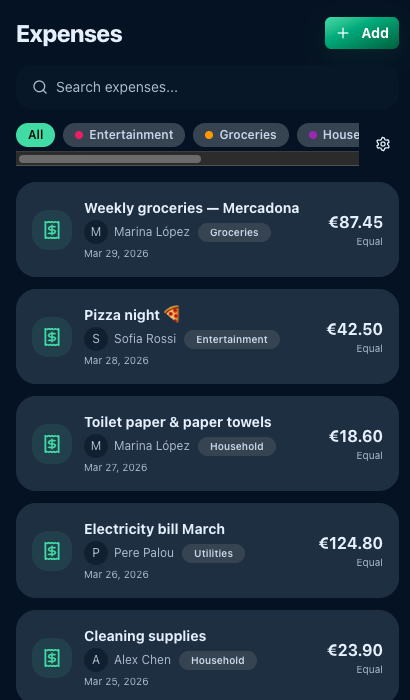
HouseKeepr
How it works: All-in-one flat management app covering expenses, chore scheduling, shopping lists, chat, house rules, and more.
Pros:
- Recurring expense templates — set up rent once, it tracks automatically every month
- Debt simplification calculates the minimum payments needed to settle balances
- Receipt scanning with OCR extracts amounts automatically
- Chore rotation, shopping lists, and flat chat in the same app
- Free tier covers up to 5 flats and 15 members
- Available in 7 languages (English, Spanish, Catalan, French, German, Italian, Portuguese)
Cons:
- Newer app, smaller user base than Splitwise
- Premium features (analytics, budgets) require paid plan at 3.99 EUR/month
Best for: Flats that want to manage everything in one place — not just expenses, but the full day-to-day of shared living. Get started free.
Quick comparison table
| Feature | Spreadsheet | Splitwise | HouseKeepr |
|---|---|---|---|
| Expense tracking | Manual | Yes | Yes |
| Recurring expenses | Manual formulas | Limited | Automatic templates |
| Debt simplification | No | Yes | Yes |
| Receipt scanning | No | Yes (premium) | Yes (free) |
| Chore tracking | No | No | Yes |
| Shopping lists | No | No | Yes |
| House rules | No | No | Yes |
| Chat | No | No | Yes |
| Free tier | Free | Ad-supported | 5 flats, 15 members |
| Languages | Any | Limited | 7 EU languages |
Whatever system you choose, the key is that every flatmate actually uses it. The best expense app in the world is useless if only two out of four flatmates log their costs.
For a deeper comparison of all the available tools, see our guide on the best flatmate management apps in Europe or the best roommate expense apps in 2026.
Special Situations: How to Handle Tricky Rent Splits
Couples sharing a room
If a couple shares one bedroom, they use the same private space as a single person. Under a room-size split, they would pay for that room like any other occupant — but their share of communal costs (utilities, internet, shared supplies) should be split per person, not per room, since two people use more water, electricity, and common areas than one.
A common arrangement: the couple pays the same rent as a single person in their room, but pays 2/N of the utilities (where N is the total number of people, not rooms).
Someone has a significantly larger room but did not choose it
This happens when one person was already in the flat and a room became available. They did not "choose" the big room — they just happen to be in it. The fair approach is still to split by room characteristics. The person in the larger room is getting more space regardless of how they ended up there. If they feel strongly that the split is unfair, offer to let them swap rooms with someone willing to take on the higher rent.
A flatmate moves out mid-lease
When someone leaves before the lease ends, the remaining flatmates need to decide whether to absorb the extra cost or find a replacement quickly. The departing person's rent obligations depend on the lease terms and local law — but for the sake of the internal split, the remaining people should re-run the calculation with one fewer person. Do not just add the departing person's share equally to everyone else unless the rooms are identical. For advice on handling flatmate transitions smoothly, see our guide on how to manage flatmates.
Short-term vs. long-term stays
If someone is staying for only a few months (Erasmus semester, work placement), they might reasonably pay a slight premium for the flexibility. Conversely, the long-term tenant who found the flat and handles the lease admin might expect a small discount. These adjustments are negotiated, not calculated — but they should be discussed explicitly rather than assumed.
Parking spaces, storage rooms, and shared amenities
If the flat comes with a parking spot or storage unit that only one person uses, add the estimated value of that amenity (check local listings for comparable prices) to that person's share rather than spreading it across everyone.
Fair Rent Splitting Methods: A Quick Reference
| Method | Best when... | Requires... | Complexity |
|---|---|---|---|
| Equal split | Rooms are genuinely similar | Nothing | Very low |
| By room size | Rooms differ significantly in area | Tape measure | Low |
| Room size + shared space | You want the most accurate formula | Measurements + calculator | Medium |
| By income | Large income differences + strong trust | Income disclosure | Medium |
| By amenities | Rooms differ in quality, not just size | Agreement on scoring rubric | High |
| Hybrid | Almost all real-world situations | Discussion + judgment | Medium |
Tips for Having the Rent Conversation
Have it before anyone picks a room
Discuss rent splitting before people move in or choose rooms. Once someone is already settled in the big room, they have no financial incentive to agree to pay more for it. Have the conversation when rooms are still abstract, and the discussion stays rational.
Use numbers, not feelings
"I think I should pay less" invites argument. "My room is 40% smaller — here are the measurements" invites problem-solving. Bring a tape measure and this guide to the conversation.
Separate rent from utilities
Rent splits might be unequal based on room size, but utility splits are usually equal since everyone uses the heating, internet, and water roughly the same amount. Treat them as separate line items to avoid confusion.
Put it in writing
Once you agree, write down the final amounts. Add them to your flat's shared document, expense app, or a message pinned in your group chat. This prevents the classic "I thought we agreed on 420" situation six months later. Having a written house rules agreement that includes the rent split is even better — it formalises the arrangement and sets expectations from day one.
Revisit annually or when things change
If someone's room becomes significantly noisier due to nearby construction, if the flat gets a major upgrade, or if a flatmate's income situation changes dramatically, be open to revisiting the split. A system that cannot adapt will eventually break.
Do not die on the hill of 20 euros
If the calculation says you should pay 487 euros and your flatmate suggests rounding to 490, just agree. Harmony in a shared flat is worth considerably more than the 36 euros per year you would save by insisting on the exact number.
Frequently Asked Questions About Splitting Rent
What is the fairest way to split rent with different sized rooms?
The fairest approach for rooms of different sizes is the room-size plus shared-space method (Method 2 above). Measure each bedroom, calculate its proportion of the total bedroom area, then split the "private" portion of rent accordingly while dividing the "shared space" portion equally. This formula accounts for the fact that everyone uses the kitchen and living room equally, while recognising that private rooms differ. In our worked example, this narrows the gap between the highest and lowest payer to 132 euros — compared to 300 euros using the basic room-size formula.
Should couples pay more than single people for rent?
If a couple shares a single bedroom, they use the same amount of private space as a single person and typically share one set of bills. Whether they pay more depends on your agreed method. Under the room-size approach, they would pay for their room like everyone else. Under an income-based approach, their combined income would factor in. Most flats treat a couple in one room the same as any other single occupant of that room for rent purposes, but charge them double for per-person utilities like electricity and water.
Can I change the rent split after we have all moved in?
Yes — but it requires everyone's agreement. The most common triggers are: a new flatmate takes over a room and the incoming person reviews whether the existing split feels right, nearby construction changes the noise profile of a room, or a renovation adds value to one room (new en-suite, improved insulation). Annual reviews are a healthy norm in any long-term flatshare. Put a calendar reminder for 12 months after move-in.
What do I do if my flatmate refuses to agree on a fair rent split?
Start with data: measure the rooms and run the numbers for a few methods side by side. Seeing the calculations often shifts the conversation from "I think" to "here is what the maths says." If one person insists on equal splits despite a major size difference, a useful framing is: "We can do equal splits, but then you get first choice of room — the smaller room goes to the highest bidder." This tends to clarify people's actual preferences quickly. If the disagreement persists, consider whether this is a sign of broader compatibility issues — how someone handles money conversations often predicts how they handle other shared living conflicts.
How do I track who has paid rent each month?
Set up a recurring expense in a shared expense app so the rent amount appears in everyone's balance automatically each month. When each person pays their share, they mark it as settled. This creates a running ledger that everyone can check and removes the need for monthly reminders and awkward "did you pay?" messages. HouseKeepr's recurring expense templates handle this automatically — set it up once and the app tracks payments every billing cycle.
Is there a rent splitting calculator I can use?
Several online rent split calculators exist, but most only handle the basic room-size method. For the shared-space method, you can use a simple spreadsheet: enter each room's square metres, calculate the shared vs. private space proportions, and apply the formulas from Method 2 above. Alternatively, apps like HouseKeepr and Splitwise calculate splits automatically when you log expenses with custom split ratios.
How should a rent increase be handled in a shared flat?
When the landlord raises the rent, apply the same splitting method you originally agreed on to the new total. If you were using the room-size method and rent goes from 1,500 to 1,575 euros (a 5% increase), each person's share increases by 5%. Do not use a rent increase as an opportunity to renegotiate the method itself — unless someone raises a legitimate concern about the original split.
What percentage of income should go to rent?
The widely cited "30% rule" — spending no more than 30% of gross income on housing — is a useful guideline but increasingly unrealistic in expensive European cities like London, Paris, Barcelona, and Amsterdam. A more practical benchmark for flatshares is 25-35% of net (after-tax) income. If any flatmate's share exceeds 40% of their net income, it is worth discussing whether the flat is affordable for the group or whether the split needs adjustment.
How do you split rent in a 2-bedroom flat with 3 people?
When two people share a bedroom and one person has a private room, the fairest approach is to charge the shared room as a single unit and divide that room's cost between its two occupants. For example, in a 1,200 EUR flat: Room A (private, 14m2) pays 520 EUR. Room B (shared, 12m2) pays 680 EUR total, split to 340 EUR per person. The shared room's total is higher because two people use more communal resources, but each individual pays less than the solo occupant.
Common Mistakes to Avoid When Splitting Rent
Defaulting to equal without discussing it. The path of least resistance is not the path of least resentment. If rooms differ at all, have the conversation.
Calculating once and never revisiting. Life changes. Rooms change. Flatmates change. Build in a review mechanism.
Ignoring utilities in the calculation. Agreeing on rent and then fighting about electricity for six months defeats the purpose. Decide on both at the same time.
Letting one person set the rules. The person who found the flat, signed the lease, or earns the most does not automatically get to decide the split. Everyone who pays rent has an equal voice in how it is divided.
Over-engineering the formula. If you need a PhD in mathematics to explain your rent split, it is too complicated. The best formula is one that everyone understands and agrees with in under five minutes.
Not accounting for shared spaces. A pure room-size split that ignores the kitchen, living room, and bathroom overcharges the person in the smallest room. Always factor in shared areas.
The Bottom Line
There is no perfect formula, but there is a reliable process: measure the rooms, pick a method together, run the calculations, and adjust until everyone agrees it feels right. The goal is not mathematical perfection — it is a split that nobody quietly resents six months from now.
The flats that handle rent splitting well share one quality: they treated it as a collaborative decision rather than a negotiation. When everyone has a voice in choosing the method and checking the numbers, the outcome tends to stick.
For managing rent alongside utilities, groceries, and all the other shared costs of living together, HouseKeepr is free to get started and handles the ongoing tracking automatically — so you can focus on actually enjoying where you live rather than chasing people for their share of the electricity bill.
Related reading:
- How to create a flatmate chore schedule that actually works
- The best flatmate apps in Europe compared
- Shared flat rules template: house rules that work
- How to manage flatmates without the stress
You Might Also Like
Ready to manage your shared home?
Start using HouseKeepr for free — split expenses, assign tasks, and keep your flat running smoothly.
Get Started Free →